Showing posts sorted by relevance for query Chago. Sort by date Show all posts

Sunday, January 3, 2021

Momentos Marcantes na Vida de Um Leitor de Banda Desenhada - 13 - Chago Armada

Chago Armada, El Humor Otro, 1963

Desta vez sei como tudo se passou. O primeiro contacto que tive com a obra de Santiago "Chago" Armada foi nas páginas da revista International Journal of Comic Art (IJOCA) que assino desde que deu a lume o primeiro número, em 1999. Refiro-me a um artigo de Caridad Blanco de la Cruz, logo no segundo ano de publicação, de que se pode ver em baixo a primeira página. 

Por coincidência esta é a entrada treze, nesta série de posts, o que me parece apropriado, do ponto de vista de quem é supersticioso, claro, não só porque estou a escrever a segunda versão deste post, depois da primeira, prontinha a publicar, ter misteriosamente desaparecido no éter da Internet, como o fatídico número se adequa à situação do autor visado...

Refiro-me a que, apesar de Chago Armada ter sido guerrilheiro na Sierra Maestra durante a revolução cubana, não se ter livrado de ver o seu livro El Humor Otro ser sequestrado durante nada mais nada menos do que vinte e cinco anos. Há aspirantes a Jdanov em todas as revoluções e quanto mais se grita liberdade na rua, menos esta pode ser exercida...

Caridad Blanco de la Cruz, com tradução de Gisela Gil-Egui, "Always the Other One: Salomón", International Journal of Comic Art, Vol. 2, #1, Primavera de 2000

Dou a palavra, com tradução minha, a Caridad Blanco (in Salomón, Ediciones Asterisco, 2017):

A saída de Salomón das páginas [do jornal] Rotograbado de Revolución, por causa da censura, significou o final abrupto do momento mais alto do humor de vanguarda nesse período [início dos anos de 1960] e de uma banda desenhada de tipo novo. Os problemas que a personagem levantou, a incompreensão que sitiou o enigmático mutante, acusado de indecente, de estar afastado do compromisso social que aqueles anos exigiam, acabaram com o exercício conceptual que Chago levava a cabo na imprensa. As suas tiras filosóficas (juntamente com as de Rafael Fornés), convidavam à reflexão, causavam surpresa e desconcerto. Queriam fazer pensar e não obter dos leitores um sorriso fácil. [Mas estes leitores eram] os mesmos que na rua, na taberna ou escrevendo ao jornal, se perguntavam sobre o significado do inusual anti-herói.

Rafael Fornés, referido acima, é o autor da personagem Sabino, como se pode ver na reprodução abaixo:

Rafael Fornés, Sabino, 2006

Não resisto a traduzir, para as citar, as palavras do próprio Chago Armada, as quais corroboram as de Caridad Blanco (in Signos #21, 1978):

Para mim, o humorismo gráfico, a partir de 1960, é um meio artístico como qualquer outro, sem limitações. Desenho com a mesma liberdade com que se compõe um poema, se pinta um quadro, ou se escreve um ensaio. Recuso as concepções sobre o humor como simples consolador bufo, comercial, cruel, panfletário, idiota. Busco factos e motivações transcendentes. Não desprezo o riso, ou o sorriso, mas procuro-o sensível, inteligente, outro. O meu propósito fundamental é fazer pensar.

Quem fala assim só pode ser um autor no sentido mais profundo da palavra. Alguém que, sem renegar a sua própria cultura (como fugir?), se mostra independente face ao dinheiro ou, neste caso, face à ideologia do Estado. Fazer esta escolha é pagar um preço bem alto e foi o que aconteceu a Santiago Rafael Armada Suarez. De certa forma não seria preciso a censura para que, a viver num país de segundo ou terceiro mundo e a praticar uma arte considerada socialmente de terceira, Chago sofresse os efeitos da periferia geográfica e da periferia estética. Mas vou ainda mais longe: no primeiro mundo o trabalho de Chago nunca seria ou será reconhecido, mesmo sem entraves, porque aí só se gasta incenso com a mediocridade, como demonstram as inúmeras e ridículas listas que aqui mesmo denunciei...

Sobre Chago Armada escrevi neste blogue uma nota breve e fiz alusão ao seu trabalho numa ou noutra entrada (é interessante o conceito, que já tinha esquecido, de "caricatura séria", tão apropriado a este post), mas, sobretudo, escrevi um breve texto para a revista Satélite Internacional, do colectivo alíngua, de que se pode ver em baixo a primeira página. Este é, diga-se de passagem, de entre os que escrevi, um dos meus textos favoritos:


Satélite Internacional #2, Dezembro de 2002
É curioso como a tese, ao tempo, estapafúrdia de incluir Frans Masereel no corpus da banda desenhada se tornou hoje um lugar-comum. Quando escrevi em cima que "banda desdenhada" não era gralha, acontece que menti. Até que era gralha, mas, tal como aconteceu a Picasso no caso que relatei, não tive coragem de a corrigir.

Sobre Sa-lo-món escreveu ainda (mais uma vez com tradução minha) e entre outras coisas, Chago Armada:
Nasce da Dialéctica Materialista, de leituras de Marx e de outros. É tese, antítese e síntese. Um homem determinado, um indivíduo e, ao mesmo tempo, todos os humanos, a colectividade. Com ele quis criar uma personagem tão vasta, complexa e contraditória como a própria humanidade. Pode ser intelectual; analisa friamente a sua circunstância. Mas também é emotivo e os seus arroubos sentimentais e irracionais conduzem-no a situações imprevistas.

Saul Steinberg exerceu uma forte influência nos caricaturistas cubanos da década de 1960. Em Chago Armada, desde logo, que pode ter lido Marx, mas viu Steinberg e em René de la Nuez. Acho, no entanto, que por ir mais fundo na condição humana, sem receio até, da escatologia, em ambos os sentidos, o discípulo superou o mestre.

Termino com a reprodução da capa de um dos livros mais importantes de Saul Steinberg e com um desenho, a aproximar-se da poesia de Chago, retirado do interior do mesmo; com uma ilustração e uma prancha de Chago Armada e com um desenho de outro dos grandes caricaturistas norte-americanos, William Steig:


Saul Steinberg, The Passport, 1954


De Salomón a Sa-lo-món: o percurso de um anti-herói (Signos #21, 1978). Sa-lo-món dentro da caixa, para além de ser uma metáfora da vinheta de banda desenhada, como disse o póprio Chago, faz lembrar o desenho de William Steig que se pode ver em baixo:
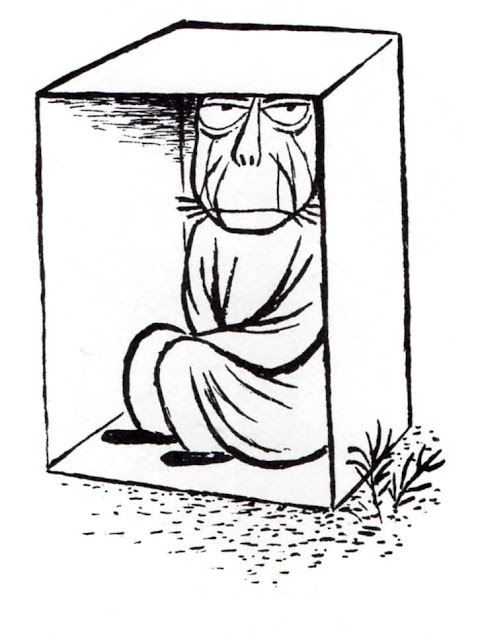

William Steig, "People Are No Damn Good", in The Lonely Ones, 1942


Prancha muito provavelmente publicada no jornal Rotograbado de Revolución, mas aqui reproduzida a partir da revista Signos #21 de 1978.

Ilustro o desenho acima com o seguinte texto de Chago Armada com tradução, mais uma vez, da minha responsabilidade (Signos #21, 1978):
Em Sa-lo-món experimentei o que denomino movimento iterado homólogo, contrário ao da banda desenhada clássica o qual se empenha em reproduzir o movimento real da vida ou o do cinema. O que realmente se move, ao ler-se uma banda desenhada, são os olhos sobre o plano (limitado) do papel, de uma vinheta para a seguinte. Assim, pode ver-se Sa-lo-món repetir uma pose (não necessariamente idêntica), uma acção essencial, um movimento indispensável, sem exaltar o estatismo ou o resíduo de um movimento, mas dinamizando o conjunto. O movimento iterado homólogo de Sa-lo-món ou de outros elementos, a distancia continua ou descontínua, cria um ritmo que é espacial e temporal ao mesmo tempo.

Em baixo pode ver-se uma prancha abstracta de Chago Armada. Também neste campo o autor foi pioneiro e revolucionário:


Signos #21, 1978 

Wednesday, October 1, 2008

Chago Armada's Sa-Lo-Mon


Considering that I have fluid criteria to "define" comics (I don't do that, really), it's obvious that I should have included Saul Steinberg in my first post (the mother of all that's following, to quote, you know who). There's sequenciality in some of his cartoons, if sequenciality is important to define the art form... Anyway, if Steinberg wasn't there, a great follower was: Chago Armada.

Santiago "Chago" Armada was born in Palma Soriano, Cuba, and was one of Fidel Castro's "guerrilleros" in the Sierra Maestra. It was there that he drew his first character: Julito 26, for El cubano libre. In 1961 he created "Sa-Lo-Mon" for Revolución newspaper. In 1963 he published his book El humor otro (another kind of humor) in which a few of his "Sa-Lo-Mon" strips and pages were republished. Considered too hermetical and, consequentially, too bourgeois, "Sa-Lo-Mon" was discontinued in 1963. The same thing happened to Rafael Fornés' "Don Sabino." Oy!...
There are two different phases in the "Sa-Lo-Mon" series: the poetical comic strip and the philosophical page. "Sa-Lo-Mon is a very simple caricature at first (he's the innocent naked human) to become a more sophisticated fool with a mask. The three syllables dividing the name Salomon are a conceptual, visual, phonetical mirror to the language of comics. With this series Chago Armada explored all things human: innocence, curiosity, scatology, wonderment, boredom, sexuality, etc... After finishing its life in comics, Sa-Lo-Mon fuelled Chago Armada's paintings (he really did abstract comics as early as the sixties). It's maddening that tons of ink and paper are wasted every day in order to publish mediocrities while this masterpiece remains completely unknown. Ry Cooder and Wim Wenders, where are you when you're needed?...

Image
: an anti children's comics cartoon by another Cuban Steinberg influenced cartoonist: René de la Nuez (El caballo de Troya, 1984).

PS: A gallery of Cuban art showing some of Chago's paintings:
http://www.galeriacubarte.cult.cu/g_artista.php?item=190&lang=eng

Chago Armada's Sa-Lo-Mon - Coda

1.

2.

3.

4.

5.

Images (1., 2., 3., 4., from El humor otro, 1963):
(1. "at noon the shadow hides under the man";
2., 3.): very simple figures convey a Leopardi type of humor;
4. Sa-Lo-Mon builds his own prison to escape afterwards using his imagination (more complex ideas were deemed too obscure to Fidel);
5. Chago Armada's painting Lo amorfo y descorazonador del diálogo vacío (the amorphous and disheartening of vacuous dialog), 1968: some of Chago's abstract paintings and drawings are clearly influenced by his comics, but not in a Neo-Dada, detached, ironical, "I'm an alchemist transforming lead into gold", kind of way. There is a very direct, very creative vein between the two (in these multi-tiered paintings with speech balloons I wonder if there's any difference). Until proven wrong I suppose that Chago Armada created abstract comics.

PS On second thought, maybe Lettriste extraordinaire Isidore Isou is also a contender.

Monday, October 15, 2018

Monthly Stumblings #7: Aristophane [Boulon]

Les soeurs Zabîme (the Zabîme sisters) by Aristophane [Boulon]

Can you imagine yourself in Kupe's lighthouse (that ideal comics library filled with books that don't exist in Dylan Horrocks' Hicksville)? I do sometimes, but, even if I wholeheartedly agree with Kupe's point of view (which is: "The official history of comics is a history of frustration. Of unrealised potential. Of artists who never got the chance to do that magnum opus. Of stories that never got told - or else they were bowdlerized by small-minded editors...") my particular lighthouse has a few books whose content does exist, but isn't available. Books like Santiago "Chago" Armada's Sa-lo-mon, or Rafael Fornés' Sabino, or James Edgar's and Tony Weare's Shannon Gunfighter or Isepinal the Apache, or Héctor Germán Oesterheld's and Francisco Solano López's Amapola Negra (Black Poppy), or Martin Vaughn-James' The Park...


Cuban artists "Chago" Armada (left) and Samuel Feijóo (photo published in Signos # 32, 1984). The drawing is Armada's.

Friday, November 24, 2017

Weird Facts - Coda

This is an anti-coda, really... In a true Derridadian spirit I'll try in this post to deny everything I wrote in my last one. I will not be able to do it completely (sorry Derrida!), but I will surely try...

So, here are, according to yours truly, the great exceptions that prove the rule...

Weird Event # 1: 19th century: comics are associated with humor and caricature.

I can't say that humor and caricature produced great works of comics art during the 19th century, but there were great artists trying (or not, I guess...). I mean Gustave Doré, when he was really young unfortunately, or the Chat Noir people, for instance... In the 20th century though, there's the towering figure of Saul Steinberg and one of his great disciples (THE great disciple surpassing the master?), Chago Armada. But I'm cheating because their work is very thinly disguised poetry (the humor, if it exists at all, is a very secondary byproduct):


Chago Armada, "Salomon," 1960s (as published in Signos # 21, 1978).

Weird Event # 2: 19th, early 20th centuries: comics are children's literature.

Two words: Carl Barks. All he did is not great, of course, but when he was good he was really good.


Carl Barks, "Uncle Scrooge in The Second Richest Duck," Walt Disney's Uncle Scrooge # 15, September - November 1956 (as published in Another Rainbow's The Carl Barks Library Set 3, book 1, 1984).

 Weird Event # 3: 1930s: comics are escapist manichean literature.

This is a tough one. How can one find great exceptions in idiocy? Even so, some pearls may be found among all the trash.


Milton Caniff, "Terry and the Pirates," (daily, October 17, 1941).

Weird Event # 4: 1960s: wanting to do other things with the medium underground cartoonists can't go beyond parody (or the same stupid adventures with sex added) because they grew up with the mediocre stuff and knew nothing else (in the end they behaved like spoiled brats):

Two words again: Justin Green. Or... Binky Brown meets The Holy Virgin Mary, to be precise.


Justin Green, Binky Brown meets The Holy Virgin Mary, March 1972. I'm not sure if the Undergrounds produced more noteworthy comics (?).

 Weird Event # 5: 1960s and on, until today: also growing up in the midst of all this trash the so-called comics critics can only write hagiographies that incense the producers who churn it out:

To be clear, I have a lot of respect for comics scholars in Academia; I have nothing against Comics Studies. The above was meant for journalists only. Even so the three words that prove the rule are: Ng Suat Tong, but I may also mention Bruno Lecigne, I guess... For the life of me I can't think of anyone else. Almost everybody incensed mediocrity at some point...

Carl Barks:

At the end of the 1920s there were two kinds of American newspaper comics: the comical comics which used caricature, and the "realist" adventurous comics. The genius of Carl Barks, and a few less talented others, like Floyd Gottfredson or Georges Remi (aka Hergé), was to join the two genres. The consequences for Barks' best stories was a parodic manicheism in which the bad guys, The Beagle Boys are a good example, were cartoonish baddies, not to be taken seriously...
On the comical side there's no slapstick. Barks' Donald Duck, for instance, is very different from the hot-tempered, always squawking, character of the animated movies. His characters are thinly disguised "real" people with all the human foibles imaginable (sex excluded, for obvious reasons). 
More later, perhaps...

Saturday, December 29, 2018

Monthly Stumblings #14: Tim Gaze

100 Scenes, a graphic novel by Tim Gaze

With Tim's permission: to Antoni Tàpies in memoriam...

Comics writer and historian Alfredo Castelli said that, even if, for the best of his knowledge, the first newspaper Sunday Comic Section in the U.S.A. to regularly adopt  the title "Comics" in short was published by the St Louis Globe Democrat in 1902, the word "comics" was well established to refer to the art form by the 1910s only. I don't know who, at the turn of the 19th to the 20th century (I suppose) first applied the already existing word "comics" to fulfil this new function...
On the other hand German art historian Wilhelm Worringer used the already existing word "abstraction" to apply it to the visual arts in the title of his book Abstraktion und Einfühlung (Abstraction and Empathy), published in 1908. The concept predated the actual invention of abstract high art by some Russian painter (probably Wassily Kandinsky, but Mikhail Larionov is also a possibility - and how about Kasimir Malevich and Czech painter František Kupka?).
I'm saying the above because I joined the two concepts and coined the expression "abstract comics" (I wouldn't be surprised if someone in the below comments proves me wrong though...). Andrei Molotiu reminisces:
I first began thinking of abstract comics as a concrete possibility during a discussion with Domingos Isabelinho on the TCJ board in the summer of 2002, on a thread with the rather awkward title, "Is there a Hemingway or Faulkner of comics?"-- or something of the kind.
I don't remember any of this to tell you the truth. In fact, I didn't pay any attention to my "discovery" (so much so that I saved a few TCJ's messboard threads, but not this one). Abstract art was, to me, such a natural thing that I mentioned abstract comics without giving it a second thought. Here's the only thing that I remember (or misremember, but I hope not...): at some point in the thread the two possible readings of a comics page came about. It's possible that I mentioned French comics scholar Pierre-Fresnault Deruelle and "his" theory of the linear (a vectorial succession of panels - what I call "a reading") and the tabular (the page as a random visual whole - what I call "roaming"). (I didn't know it at the time, but said analysis is not by Deruelle who published it in 1976. Said theory's author is Gérard Genette who published it in 1972 - he called the former a "successive or diachronic reading" and the latter a "global and synchronic look[.]") to illustrate these two readings I posted the image below by Lettrist writer, filmmaker and draftsman, Isidore Isou:


Isidore Isou, 1964.

I said at the time that the page could be read/viewed in two ways: (1) as a drawing (the global look), (2) as an abstract comic (the successive reading). (I don't remember my exact words back then, but I don't want to imply now that the former isn't part of a comics reading proper.) Anyway, this took too much space already and, in the doubtful chance that you, dear readers, are still interested, too much of your patience and time. Sorry for the self-indulgence!...
Contrariwise to what happened with Wilhelm Worringer the expression "abstract comics" didn't predate abstract comics. Looking back we may found many examples in other fields. The one below is by Portuguese visual poet Abílio:


"Humor" by Abílio, 1972.

My favorite example comes from the comics field though. I mean the following example from Cuba:


The Amorphous and Disheartening of Vacuous Dialog by Chago Armada, 1968.

One of the roots of abstract art is Symbolism, the Gauguin inspired Nabis especially as we can see below:

The Talisman, the Aven River at the Bois d'Amour by Paul Sérusier, 1888.

It was fellow Sérusier Nabi painter Maurice Denis who said:
Remember that a painting, before being a battle horse, a nude woman or any anecdote, is essentially a plane surface covered with colors assembled in a certain order.
Kandinsky's abstract art was born in an atmosphere similar to the Pont Aven one, in Munich this time. I mean the Blaue Reiter (the blue rider) lyrical Expressionist group, of course. Around 1912, when his book Concerning the Spiritual in Art was published, Kandinsky was interested in Theosophy and Symbolism (he admired Belgian poet Maurice Maeterlinck). In fact, when he seemed to be occupied mainly by formal problems he stressed the importance of his work's content (1925):
I would really like the spectators to go beyond the fact that I chose triangles and circles. I would like them to see what's behind my paintings because that's the only thing that interests me. I always viewed the problems of form as secondary... I know that the future belongs to abstract art and I'm dismayed when other abstract painters don't go any further than form...

First Abstract Watercolor by Wassily Kandinsky, 1910.
 Other wings of abstract art starting with Malevich and the Constructivists will be more formalist, but we'll have to jump a few years in order to arrive at Tim Gaze's book 100 Scenes, a graphic novel. Before leaving Kandinsky, for now, I want to stress what's in common between the two: they both had/have an interest in music (in Tim's case it's Dubstep). Following Lithuanian painter and musician Mikalojus Ciurlionis, Kandinsky believed in a synesthetic relation between colors and sounds (1912):
Yellow is disquieting to the spectator, pricking him, revealing the nature of the power expressed in this color, which has an effect on our sensibilities at once impudent and importunate. This property of yellow affects us like the shrill sound of a trumpet played louder and louder, or the sound of a high pitched fanfare. Black has an inner sound of an eternal silence without future, without hope. Black is externally the most toneless color, against which all other colors sound stronger and more precise.
It's easy to know where Tim Gaze is coming from because he tells us so in his Notes. He cites three main references: Andrei Molotiu's abstract comics and "ground-breaking volume Abstract Comics: The Anthology (2009)[;]" Surrealist art and techniques (collage books and decalcomania paintings by Max Ernst); Henri Michaux's Tachiste (Pierre Guéguen, 1954) sequential work. One may say that, briefly, Surrealists and Tachists (Informal Art, Art Autre - Art of Another Kind -, as Michel Tapié put it in 1951, 52) advocated a spontaneous, irrational, kind of art. Both groups were fascinated by drug use, magic, popular art and, sorry for using an expression that I don't like much, outsider art (Jean Dubuffet's Art Brut)... Informal artists are the European equivalent of the Abstract Expressionists in the U.S.A..


100 Scenes, A graphic Novel by Tim Gaze, 2010. 

Tim Gaze says that his graphic novel "touches upon two emerging areas: abstract comics [...]  and asemic writing." I'm with Kandinsky when he said that "[t]here is no form, there is nothing in the world which says nothing." Writing may be asemic as writing, but a sign is a visual entity signifying with visual means (as Tim put it: "[t]hese areas transcend languages, and offer the possibility of inter-cultural communication without words." (Just like music, right?...) As Tim puts it, polysemy is high in his book:
This is an open novel, for you to project your mind into.
Every page is a stimulating field for your imagination.
So, there's no predetermined meaning here, entropy is at its fullest, we have achieved maximum energy.
We may start with the cover of 100 Scenes above. I asked Tim if the book had anything to do with Katshushika Hokusai's One hundred views of Mt. Fuji. He answered me that "only the title has any connotation of Hokusai." So, false clue there, I would say... First of all: is this a novel as the cover claims? How can it be if there are no characters or plot? Isn't the concept of "graphic novel" stretched to the breaking point? I would answer yes to the first question and no to the last one. We don't even need to go further than the cover to understand these answers. There are at least two reasons to explain them:
(1) The cover of a book is what Kandinsky called, the basic plan. Without the title (without the words) the basic plan would be a square (as we can see above). So, it's the book's format that limits the basic plans' choice.
(2) A drawing on a gallery wall (or a comics original panel) has a materiality (white pentimenti, irregular intensities of black, the paper texture, etc...) lacking here. What we have above is an image of an image of an image (a copy of a monoprint): i. e.: in McLuhan's terms the hot drawing cooled down creating a distance that, in Benjaminian terms, provoked the loss of its aura. Hence: there's a movement from the visual arts to literature: the graphic novel...
Having established that we may now answer the second question: the comics people co-opted the word "novel," but graphic novels have their own specificity being nothing like novels.
The drawings in 100 Scenes result from various tensions, then (to use another Kandinskyan word): human made / machine reproduced; line / texture; black / white; positive space / negative space; centered / decentered; stillness (the basic plane) / movement (the drawings); chaos / order; regular rhythms / irregular shapes; etc... From page to page we witness a restless, lively world. It's like a godless theogony (another tension?) in which trial and error coexist. I'm on the verge of denying the abstract nature of this graphic novel, so, I'll stop now...


Page from 100 Scenes: the regular rhythm, the irregular shapes, in ascension.

I'll finish with part of Henri Michaux's postface to Movements, 1951:
Whoever, having perused my signs, is led by my example to create signs himself according to his being and his needs will, unless I am very much mistaken, discover a source of exhilaration, a release such as he has never known, a disencrustation, a new life open to him, a writing unhoped for, affording relief, in which he will be able at last to express himself far from words, words, the words of others.

Page from Movements by Henri Michaux, 1951.

Thursday, September 25, 2008

My Comics Canon

It was February 24, 2004, 08:27 AM, on the Comics Journal Messboard. I'm not sure if this was the first time I listed these comics there (probably not), but that's what I did in that particular occasion. If I remember correctly (unfortunately I didn't write a crib sheet at the time) I did previously post what I now call "my canon" because I was fed up with the accusation of not liking comics at all because I found children's comics (and I do like Carl Barks' oeuvre) somewhat wanting (melodrama and manichaeism in particular bother me plenty).
This is a different list because I added a few titles over the last years: My Canon:

Anon (Cantigas de Santa Maria de Alfonso X El Sabio)
Hans Holbein (Les Simulachres & Historiées Faces de la Mort)
Gilles Corrozet (Les Simulachres & Historiées Faces de la Mort)
Romeyn de Hooghe (The Siege and Liberation of Vienna in 1683)
Jacques Callot (Les misères et malheurs de la guerre)
William Hogarth (A Harlot’s Progress; Rake’s Progress)
Francisco de Goya (Los desastres de la guerra; Caprichos de Goya)
Katsushika Hokusai (Thirty-Six Views; One Hundred Views of Mt. Fuji)
Gustave Doré (Histoire de la Sainte Russie)
Gustave Henri Jossot (Le credo; Dressage)
Theophile Alexandre Steinlen (La vision de Hugo)
Frans Masereel (Mein Stundenbuch; Die Stadt)
George Grosz (Ecce Homo)
Pablo Picasso (Songe et mensonge de Franco; La suite Vollard)
Charlotte Salomon (Leben? Oder Theater?)
Francis Bacon (Triptych May - June 1973)
Héctor Germán Oesterheld (Ernie Pike; Amapola Negra, Mort Cinder; El EternautaRandall, Loco Sexton)
Alberto Breccia (Ernie Pike; Mort Cinder; Un Tal Daneri; VersionesLa Gallina Degollada; Buscavidas)
Hugo Pratt (Ernie Pike)
Carlos Trillo (Un Tal Daneri; Buscavidas)
Solano Lopez (Amapola Negra, El Eternauta)
Arturo del Castillo (Randall, Loco Sexton)
Tony Weare (Matt Marriott)
James Edgar (Matt Marriott)
David Wright (Carol Day: Jack Slingsby)
Chago Armada (Sa-Lo-Mon)
Guido Buzzelli (Zil Zelub; I Labirinti; L’Agnone; Intirvista)
Philip Guston (Poor Richard)
Roy de Forest (Too The Far Canine Range And The Unexplored Territory Beyond Terrier Pass)
Nicholas Africano (The Scream, Struggling with him, He's afraid of loneliness)
Martin Vaughn-James (The Cage, The Park)
Yoshiharu Tsuge (Red Flowers; Oba’s Electroplate Factory; L’homme sans talent)
Ana Hatherly (O Escritor)
Fred (Le Petit Cirque; Le journal de Jules Renard lu par Fred)
Dino Buzzati (Poema a fumetti)
Tardi (La bascule à Charlot; C'était la guerre des tranchées; La veritable histoire du soldat inconnu)
Edmond Baudoin (Le portrait; Le premier voyage; Éloge de la poussière; Terrains vagues; Couma àco)
Richard McGuire (Here)
Andrzej Klimowski (The Depository: A Dream Book; The Secret)
Martin tom Dieck (hundert Ansichten der Speicherstadt; Monsieur Lingus; Territirroirs)
Fabrice Neaud (Journal (I); Journal (III))
Chester Brown (The Playboy; I Never Liked You)
Lynda Barry (The Freddie Stories; The Most Obvious Question; One! Hundred! Demons!)
Anke Feuchtenberger (Die Hure H; Die kleine Dame; Somnanbule)
Katrin de Vries (Die Hure H; Die kleine Dame)
Geneviève Castrée (Lait Frappé, Susceptible)
Shannon Gerard (Unspent Love; Hung)
Debbie Drechsler (Daddy's GirlThe Summer of Love)
Kiriko Nananan (Blue)
Nick Drnaso (Sabrina)
Ben Katchor (Julius Knipl Real Estate Photographer;The Jew of New York)
Eric Lambé (Ophélie et les directeurs des ressources humaines; Alberto G.; La Pluie; Un voyage)
Stefano Ricci (Tufo)
Philippe de Pierpont (Alberto G.; Tufo; La Pluie; Un voyage)
Jiro Tanigushi (L’homme qui marche; Le journal de mon père)
John Porcellino (Sam; Perfect Example)
Ed Brubaker (Here and Now, An Accidental Death)
Stefano Gaudiano (Here and Now)
Eric Shanower (An Accidental Death)
Sylvain Victor (Le Doute)
Vincent Fortemps (Cimes; La Digue; (Coulisse); Par les sillons)
Olivier Deprez (Le Chatêau)
Olivier Marboeuf (Une Ville, un Mardi)
Pierre Duba (L'Absente; Racines)
Dominique Goblet (Souvenir d’une journée parfaite; Faire semblant c’est mentir)
Andrea Bruno (Sabato Tregua)
Chris Ware (Jimmy Corrigan, The Smartest Kid on Earth; Acme Novelty Library # 18; Building Stories)
Barron Storey (The Adjustment of Sidney Deepscorn; Slidehouse)
Carl Barks (The Twenty Four Carat Moon; Valley of Tralla La; Back to Long Ago; A Financial Fable)
Yoshihiro Tatsumi (Goodbye and Other Stories; Kept)
Harvey Pekar (American Splendor # 4; American Splendor # 8)
Robert Crumb (American Splendor #4; American Splendor #8)
Jose Muñoz (Sudor Sudaca; Alack Sinner)
Carlos Sampayo (Sudor Sudaca; Alack Sinner)
Gary Panter (Daltokyo; Cola Madnes)
Art Spiegelman (Maus)
Carel Moiseiwitsch (This Is a True Story)
Federico del Barrio (El artefacto perverso; Lope de Aguirre, la conjura; Las memorias de amoros; La Orilla)
Elisa Gálvez (La Orilla)
Felipe Hernandez Cava (El artefacto perverso; Lope de Aguirre, la expiación; Lope de Aguirre, la conjura; Las memorias de Amoros; Soy mi sueño)
Pablo Auladell (Soy mi sueño)
Ricard Castells (Lope de Aguirre, la expiación)
Aristophane (Les Soeurs Zabîme; Conte démoniaque; Faune)
Montesol (Fin de semana; Speak Low)
Ramon de España (Fin de Semana)
Joe Sacco (Palestine; Safe Area Gorazde; The Fixer; Footnotes in Gaza)
Mattotti (Stigmate; Il rumore della brina)
Jorge Zentner (Il rumore della brina)
Claudio Piersanti (Stigmate)
Eddie Campbell (The King Canute Crowd; Graffiti Kitchen; Alec: How to Be an Artist; From Hell)
Alan Moore (From Hell)
Mat Brinkman (Teratoid Heights; Heads 44)
Yvan Alagbé (Dyaa; Nègres jaunes)
Thierry van Hasselt (Brutalis)
David B. (L’Ascension du Haut Mal)
Daniel Clowes (Ghost World; David Boring)
Peter Blegvad (The Book of Leviathan)
Blanchet (La nouvelle au pis)
Max (El prolongado sueño del Sr. T.; Nosotros somos los muertos; Bienvenidos al infierno)
Seth (Clyde Fans; It’s a Good Life if You Don’t Weaken)
Rutu Modan (Jamilti; Exit Wounds)
Pedro Nora (Mr. Burroughs)
David Soares (Mr. Burroughs)
Filipe Abranches (A Morte do Palhaço)
Marco Mendes (Diário Rasgado)
David Mazzucchelli (Big Man; Discovering America; Asterios Polyp)
Moebius (Cauchemar blanc)


Image:

Carol Day by David Wright (strip # 2963). In the last panel we can see a medium close-up of Adam Boone, a character "played" by Matt Marriott's co-creator, Tony Weare.

Friday, November 17, 2023

The Labyrinth by Guido Buzzelli


Guido Buzzelli, The Labyrinth, Floating World Comics, 2023 [1970]

Since Google's policy is to delete dead accounts I'm reviving this blog to announce that I wrote the Intro to the above book. I hope it does well out there...

Guido Buzzelli is, as you know, if you have been following this blog, a favorite at The Crib, the others being Héctor Germán Oesterheld, Chago Armada, James Edgar, Tony Weare, Yoshiharu Tsuge, John Porcellino, and a few others...

I must also add the following: I was so shocked by João Paulo Cotrim's death, and since I mentioned him on my last post, that I froze, not knowing what to say... He died way too soon...   


João Paulo Cotrim, Photo by Tiago Fezas Vital 

Tuesday, September 25, 2018

Ten Years Already!


It was Thursday, September 25, 2008: the day I wrote my first post on The Crib.
In my last post I wrote "Ten years is a long time in a person's life". What changed, according to yours truly, natch, in these ten years, both personally and in the comics field?

Personally I don't have much to say: let's just disclose that I'm less and less inclined to write and leave it at that... Proof enough of what I'm saying is my failing to deliver (thanks again to the seven of you who showed interest in reading my putative twenty five texts!, unfortunately I wrote only two!).

In the comics field many things changed. If we take Berlin by Jason Lutes and Clyde Fans by Seth (I still haven't read these fine graphic novels, I'm sure they are fine, in a sitting, something I intend to do in a not so distant future) we reach the following conclusions: first there were the pamphlets, then the volumes, and now the brick (or, in Berlin's case, the third volume and the brick at the same time). These are hinge books that were done over a huge period of time. Hence they witnessed the end of the pamphlet, the end of the trade paperback collection, and the triumph of the graphic novel. 

Are we better or worst than we were ten years ago? Sincerely, I'm not sure... Maybe it's just me and I lost touch with the field (I still haven't read My Favorite Thing Is Monsters or Sabrina or Barcazza, for instance), but I don't see any improvements, on the contrary. Don't ask me to explain why either, it's just a vague feeling, maybe provoked by my insistence in following my generation of creators (those so many who promised so much at the beginning of the 1990s and remain so few now) and my lack of interest in finding new voices... their drawing styles and sterile experiments leave me cold, to tell you the truth...


Héctor Germán Oesterheld (w), Francisco Solano López (a), "Amapola Negra - 'Black Poppy'," Hora Cero # 15,  July 1958.

Enough whining and on to another thing. Since I promised and I didn't deliver, as I said above, at least I'm posting the list of my favorite comics as a kind of commemoration for The Crib's ten years. It's a list of 34 with a couple of "anomalies": John Porcellino, for instance has two titles at number 7; ditto Seth at number 18. Is this list wanting in gender and ethnicity equality? Yes it is and I have no excuses: I also refuse any kind of positive discrimination. 

Could this list be different? Of couse it could. Early on I discovered that this is an impossible task. To do it right is a full time job in itself. Most of the stories below are there because I vaguely remember liking them years ago. Would I like them as much upon rereading? I'm not so sure...

There's no Picasso, Goya or Hokusai below. Needless to say that they would be number one, two and three, with Jacques Callot following, in a more open minded list. These are my favorite restrict field comics, not my favorite comics, period.

1 – Amapola Negra – Black Poppy (Héctor Germán Oesterheld, Francisco Solano López)
2 – Matt Marriott: Isepinal the Apache (James Edgar, Tony Weare)
 Muno no Hito [The Man Without Talent] (Yoshiharu Tsuge)
4 – Convoy a Malta (Héctor Germán Oesterheld, Hugo Pratt)
5 – Zil Zelub (Guido Buzzelli)
6 – Sa-lo-mon (Chago Armada)
7 –  Sam / Perfect Example (John Porcellino)
8 – Le journal de Jules Renard lu par Fred (Fred)
9 – Randall: Jinetes Vengadores (Héctor Germán Oesterheld, Arturo del Castillo)
10 –  Fuck (Chester Brown)
11 – Les soeurs Zabîme (Aristophane)
12 – Sudor Sudaca (Carlos Sampayo, José Muñoz)
13 – The Most Obvious Question (Lynda Barry)
14 – Journal III (Fabrice Neaud)
15 – Conte demoniaque (Aristophane)
16 – La Orilla (Elisa Gálvez, Federico del Barrio)
17 – Nègres jaunes (Yvan Alagbé)
18 – Calgary, Clyde Fans (Seth)
19 – Graffiti Kitchen (Eddie Campbell)
20 – Haruka-na machi e [A Distant Neighborhood] (Jiro Taniguchi)
21 – Carol Day: Jack Slingsby (David Wright)
22 Un tal Daneri (Carlos Trillo, Alberto Breccia)
23 – La bascule à Charlot (Jacques Tardi)
24 – Building Stories (Chris Ware)
25 – El artefacto perverso (Felipe Hernández Cava, Federico del Barrio)
26 – Le portrait (Edmond Baudoin)
27 – Par les sillons (Vincent Fortemps)
28 – Aruko Hito [The Walking Man] (Jiro Taniguchi)
29 – El prolongado sueño del Sr. T. (Max)
30 – Speak Low (Montesol)
31 – Somnambule (Anke Feuchtenberger)
32 – La Pluie (Philippe de Pierpont, Eric Lambé)
33 – Safe Area Gorazde (Joe Sacco)
34 – The Adjustment of Sydney Deepscorn (Barron Storey)

Thursday, November 12, 2009

Anke Feuchtenberger's Somnambule


Anke Feuchtenberger is a German graphic designer and comics artist. In a recent interview by Mark Nevins (European Comic Art, Volume 2, # 1, Liverpool University Press: 65 - 82) she talked about her influences (67, 68): "Well, I grew up in East Berlin, in a house full of art books. My father was a graphic designer, and my mother was an art teacher. So rather than children's books, I spent a lot of time looking at art books. These were strange books for a five-year-old girl, things like the posters of John Heartfield, books about Käthe Kollwitz and Rodolphe Töpffer, and collections of paintings from the Italian Renaissance. My father had a lot of catalogues from the 'Poster Biennales' in Warsaw and Finland, and I loved to look at those posters. I also really liked the work of some of the Renaissance painters, especially Matthias Gruenewald [sic] and Hieronymus Bosch. Those images filled my imagination every day. [...] One of my early very serious experiences with art came when I was 15 years old. I got up all my courage and visited a female painter I adored, and I showed her my drawings. Her name is Nuria Quevedo [http://www.galerie-berliner-graphikpresse.de/?page_id=153]. She's Spanish, and was in exile in East Germany." Anke Feuchtenberger also says, in the same interview, that she doesn't like Picasso's work. That's strange though: Nuria Quevedo's influence is easily traceable in Feuchtenberger's style, and Picasso's influence is also easily traceable in Quevedo's paintings. Quevedo did serious caricatures like, for instance, Chago Armada. I wonder if that's one of the usual features in Second World graphic artists. Maybe José Alaniz's book on Komics (comics from Russia: http://www.upress.state.ms.us/books/1199) will talk a bit about the subject. I also wonder who started doing that? My bet is Pablo Picasso, but I could be wrong (George Grosz and Saul Steinberg are other possibilities and Paul Klee and William Steig come to mind... but maybe Gus Bofa is the real name to cite here; I guess that an historical investigation is in order...). Anyway... there's a thin line between caricature and expressionism... It would be very difficult to determine which expressionist drawing is no longer expressionist, but a "serious" caricature and vice-versa... Besides, who can say for sure if William Steig's lonely ones (Duell, Sloan & Pearce, 1942: http://tinyurl.com/ygcwhln ), for instance, are funny or "serious," or both?...
Talking about one of her most famous books, with Katrin de Vries (Die Hure H, Jochen Enterprises, 1996; W the Whore, Bries, 2001), Anke Feuchtenberger seems to confirm the idea that her work may be labeled "feminist" (ditto: 81): "Her name [Die Hure H] should create fantasies about danger, pleasure, sexuality, and so on. We used the character as a door which opens up wide possibilities for thinking about the female body, the history of the female body, and the opportunities for a woman in society [...]."
The "message" in "Die see jungfrau" (the young woman from the sea, according to my translation: published in Die kleine Dame - the little lady -, Jochen Enterprises, 1997), a story also written by Katrin de Vries (and inspired by Hans Christian Andersen's "Den lille havfrue," the little mermaid, published in Eventyr, fortalte for Børn, fairy tales told for children: C. A. Reitzel, 1837), focuses on the politics of the female body. Unfortunately I don't speak German, but it seems to me that the young woman from the sea refuses her identity and wants to be a normal (or should I say: standardized) woman. In order to become one she doesn't hesitate to bleed to death because she cuts her fish tail in two.
Anke Feuchtenberger's Somnambule (an almost wordless book, by the way; Jochen Enterprises, 1998) goes the other way around destroying the simplistic feminist labeling... Here we can find one of Feuchtenberger's more recognizable visual metonymies: the detached (flying) head (strangely enough this is the second time that this metonymy appears at The Crib: the first one it belonged to - with some differences nonetheless - Edmond Baudoin). In "Gewächs haus," the greenhouse (a story inspired by Katrin de Vries), a man is the victim because, even if he tries to fly away using his propeller head, he can't do it. Two women keep him captive shaping him in their way, planting him, really (hence the title).
These stories are about power and domination, about killing what one loves (it's the mystery of the vowels again: another link to Edmond Baudoin: cf. my post about him). To confirm everything that I said so far you may read/see "Blind Schleich Song," something like "blind creep song," acording to an internet translator (a story that's part of Somnambule), here: http://www.feuchtenbergerowa.de/gal.htm (a male human caterpillar tries to flee using his head propeller, but the human female bunny character doesn't let it; the caterpillar's head detaches itself from the body functioning as the moon, or a night light; in order to read this story you just have to think about the caterpillar as a stage before a metamorphosis occurs - the body turns into a butterfly - and a head detaching from the body as a sign that the latter can be imprisoned - in this case: prevented from growing up -, but our imagination can't be contained; even so, the head loves the bunny because it stays with it nonetheless).
It downs on me now that this post should have been called something like: Anke Feuchtenberger's and Katrin de Vries' beautiful stories... The latter isn't really the author of Somnambule, but she greatly influenced Anke Feuchtenberger's work during the mid to late nineties.
She also deserves to be in The Crib's canon.

Anke Feuchtenberger's site: http://www.feuchtenbergerowa.de/
Anke Feuchtenberger's and Stefano Ricci's boutique publishing house: http://www.mamiverlag.de/

Images:
Somnambule's wraparound cover cut in two halves like the see jungfrau's tail (Jochen Enterprises, 1998): our old selves are falling behind us all the time while new ones are born...

PS Feminists are, to me, the best critics of mainstream comics writing today. This happens because, being mostly male, other critics overlook misogynous messages and buy every stupid fantasy that passes for art in mainstream comics. That said I strongly endorse a visit to this particular post ("Bingo: The Callers Enclue You") in Karen Healey's blog:

Girls Read Comics and they're pissed:
.