Showing posts sorted by relevance for query Oesterheld. Sort by date Show all posts

Saturday, December 27, 2014

Ernie Pike - Coda #1

If you ask any European comics reader about "Ernie Pike" s/he will tell you that Ernie Pike is a comic by Hugo Pratt. Some, but not many, will tell you that "Ernie Pike" is a comic by Hugo Pratt, scripted by Héctor Germán Oesterheld. Few, if any, will mention Jorge Oesterheld at all. And none, I'm sure, will tell you that Hugo Pratt drew, give or take, 10 % of the series only.

Who drew the other 90 %, then? Well, 46 draftsmen did (not counting Ernie Pike Coleccion Batallas Inolvidables and Ernie Pike in Top and Skorpio)...

Today I'm starting a series of posts showing Ernie Pike, the character as drawn by all its creators in alphabetical order. Take this as a homage to all the artists who are forgotten!...

(As legend tells us, Oesterheld was inspired by the American war correspondent Ernie Pyle to create Ernie Pike. On the other hand Hugo Pratt created Ernie Pike using Oesterheld's likeness. He had done the exact same thing a few years before in Misterix with the character Scribe in the "Sgt. Kirk" series.)


Aguilar (a), Héctor Germán Oesterheld (w), "Ernie Pike: Heroísmos inútiles," [useless heroisms] Frontera # 49, April 1961.


Victor Hugo Arias (a), Jorge Oesterheld (as Jorge Mora - w), "Ernie Pike," Hora Cero # 35, March 1960.


Jesus Balbi (a), Héctor Germán Oesterheld (w), "Ernie Pike," Hora Cero Extra! # 37, February 29, 1961.


Victor Hugo di Benedetto (a), Héctor Germán Oesterheld (w), "Ernie Pike: Un raro episodio," [a strange episode] Hora Cero # 52, August 1961.


José del Bó (a), Héctor Germán Oesterheld (w), "Ernie Pike: Su mejor crónica," [his best column] Hora Cero Extra! # 41, May 16, 1961.


Alberto Breccia (a), Héctor Germán Oesterheld (w), "Ernie Pike: El amuleto," [the amulet] Hora Cero # 24, April, 1959.


Gabriel Cafa (as Yabar - a), Héctor Germán Oesterheld (w), "Ernie Pike: Ingenio," [ingenuity] Hora Cero # 50, June, 1961.

Al Caruso (a), Héctor Germán Oesterheld (w), "Ernie Pike," Frontera # 46, January, 1961.


Juan Lucas Castro (a), Héctor Germán Oesterheld (w), "Ernie Pike: Medalla del Congreso," [Congress medal], Hora Cero Extra! # 58, February 13, 1962.


Eugenio Colonnese (a), Héctor Germán Oesterheld (w), "Ernie Pike: Medallas," [medals], Hora Cero Extra! # 12, August, 1959.


PS Many thanks to Carlos Altgelt for the data.


Sunday, August 31, 2014

Death As a Character

March 5, 1975, somewhere in Argentina: Carlos Trillo and Guillermo Saccomanno interviewed Héctor Germán Oesterheld (Oesterheld was living underground already for political reasons; the interviewer, Saccomanno, means the characters): 
"Why do you always kill them all?
Because of that character no one really takes advantage of, which is death." 
This Blog is dangerously becoming monographic, but a Blog is a log, after all, and I write about what interests me at any particular moment. The day my focus turns elsewhere my posts will change accordingly, of course... That said I feel more and more that, maybe, I should be writing in Spanish because Oesterheld's work will never be published in any English speaking country. I don't do it in the hope that many (yeah, right!) readers talking many languages (Spanish included) understand our modern (and post-modern) Latin.

The fact that no English speaking country will ever publish Oesterheld's work is yet another symptom that comics are not an art form like all the others. Even in today's Barbarian times it's a bit unthinkable (but is it, really?) that an English speaking country wouldn't publish Kafka or Proust. Worst than that though: excluding El Eternauta [the Eternaut], for political, more than aesthetic reasons, Oesterheld's work isn't even published (reprinted) in Argentina (Where's Randall, where's Sgt. Kirk, where's Bull Rockett, where's the complete Ernie Pike, Amapola Negra, Ticonderoga, Mort Cinder, 'Loco' Sexton in a restored fac-simile edition with good production values?)

Anyway... I started this post quoting Oesterheld himself talking about the death of his secondary characters and the death of his protagonists even (like Randall in the series "Randall, 'the Killer'"). In highly formulaic action stories the bad guys are always awful shooters while the hero kills twenty with a slug. Oesterheld couldn't go against that completely, of course, because he worked, after all, in a commercial context, but he could (and did) minimize the unconvincing parts of the formula. He used a few strategies to do that: the most important, because it has ethical consequences, was to avoid (again, not completely) Manicheism; another one explained his protagonist's victory with said protagonist's intelligence, rather than violent inclinations; the death of the good guys was another one (in a war no one is safe). His masterpiece, according to strategies one and three (it's not even a pop story, in my humble opinion) is "Amapola Negra - 'Black Poppy'." But "Amapola Negra" and "Ernie Pike" were published in Oesterheld's own Editorial Frontera (and so was "Randall"), which meant that he had more freedom to do whatever he pleased...

I'm not talking about Editorial Frontera here, though. The examples that I show below (besides the great death of Randall) are part of Oesterheld's career outside of his publishing house: in Abril and Columba (early to mid 1950s and early to mid 1970s).

  
Héctor Germán Oesterheld (w), Hugo Pratt (a), Stefan Strocen (c), "El Sargento Kirk: El pais de los mungos" [Mungo Country], Editorial Abril, Misterix # 353, July 7, 1955. "El pais de los mungos" found the trio in a creative state of grace. It was in 1955 that Hugo Pratt found his later style and Stefan Strocen reached a peak in his work for Misterix.

I'm not completely sure, but I think that Dinard's death above may very well be the first disappearance of a main character in Oesterheld's oeuvre. It's interesting how Corto (yes, exactly like in Corto Maltese) deflates the drama. A fight was going on and they didn't have the time to stop and mourn. Here's what Corto said after Maha gave him the news of Dinard's death: "Good for him. What can a man want more than to die as he lived?"


Héctor Germán Oesterheld (w), José Luis Garcia López (a), I don't know who the colorist was, "Roland el Corsario: Algo más que un reino" [something more than a kingdom], Columba, Fantasía # 236, January 1974.

Columba was a traditional highly commercial publishing house. Oesterheld ended up working there because he needed to put bread on the table. However, he was such a towering figure (the writer of El Eternauta, no less) that his editors and publishers gave him some creative autonomy. That's why he could kill off some of the characters, as seen above. 

Below, the poetic death of Randall...


Héctor Germán Oesterheld (w), Arturo del Castillo (a), I don't know who the letterer was, "Randall, 'the Killer': Jinetes vengadortes" [vengeful riders], Editorial Frontera, Hora Cero Suplemento Semanal # 28, December 3, 1958. Here's what's in the captions in the three last panels: "It was then that the vital spring that tied him to life yielded. / Because of his efforts blood spurted from his reopened wound. The red lymph mixed with the recently stirred dirt... / ...and continued to run down, as if seeking to warm up the already freezing bosom of Martine."


Milton Caniff, "Terry and the Pirates," News Syndicate, the death and burial of Raven Sherman in three consecutive daily strips: October 15 - 17, 1941.

Readers reacted strongly against the death of both Randall and Raven Sherman. So much so that Oesterheld had to resurrect his character and MIlton Caniff never repeated such a stunt again. "Terry and the Pirates" was a mediocre juvenile adventure strip during the 1930s. It improved a bit during WWII, but, besides some good qualities (Caniff's female characters, Burma and Hu Shee especially, and some interesting story arcs - the excellence of the art, and I mean technically, and the colorful language aren't even worth mentioning) it never surpassed, if I remember correctly, stereotyping (Connie is overtly racist) and Manichean formulas. He explained very well why he killed Raven though (it's reason number 3):  
"Ever after that if somebody in the strip became ill or hurt or hit by a car or thrown off the back of a truck, the reader knew - well, Jesus, he killed off Raven Sherman, and now he's going to kill off this character. That's the real reason for doing it, to put credibility in there, instead of - oh, well, he'll get out of it somehow or come back to life or something. Soap opera stuff."


Tuesday, September 18, 2018

Monthly Stumblings #3: Héctor Germán Oesterheld, Francisco Solano López

Héctor Germán Oesterheld's and Francisco Solano López's "Enterradores" (gravediggers)

A curious thing happened when Argentinian scriptwriter Héctor Germán Oesterheld found his own comics publishing house, Editorial Frontera. For a brief period of time, 1957 - 1963, mainstream adolescent comics raised much above the business as usual, pervasive formulaic dreck. Oesterheld proved to me a very simple and often forgotten truth: it's easy to dismiss a whole category if we base our judgment on the worst examples (usually those are the only ones that the judges know about). It's easy to debase something when the judge is socially much above the subject of her/his scorn; in these circumstances s/he can only be applauded by her/his peers while all outraged reactions can't be heard outside of the attacked subculture.
I don't defend adolescent comics, mind you, I'm just saying that when the best comics writer ever decided do try a hand at this particular genre (if we can call it that) the inevitable happened. Here's what he had to say in Hora Cero Suplemento semanal (zero hour weekly supplement) # 1 (September 4, 1957):
There are bad comics when they're badly done only. Denying comics all together, condemning them as a whole, is as irrational as denying cinema all together because there are bad films. Or condemning literature because there are bad books. There are, unfortunately in a huge ratio, lots of bad comics. But these don't disqualify the good ones. On the contrary, by comparison, they should underline their quality. [...]
Oesterheld is a German family name and Héctor inherited a German tradition which, according to Christian Gasser (in the Lisbon comics convention catalog, 2003) dates from the enlightenment:
This didactic interpretation of literature is a product of the 18th century. At that time, the qualities of literature and art were used to educate and morally elevate the common people. Meanwhile, these efforts became obsolete in literature, but not in the restricted domain of children's literature where people continue to ask: "Very well, what can a child learn from this book?" The pedagogic function continues to be overrated.
Oesterheld viewed the, then, popular medium of comics as an opportunity to reach hundreds of thousands of children and adolescents. At a certain point he felt the need to put the following warning on the cover of Hora Cero Suplemento Semanal: "Historietas para mayores de 14 años" (comics for those who are older than 14). The anti-comics crusade was still on and he didn't want any trouble. Anyway, he wanted to both educate and entertain. What he meant by "educate" wasn't exactly what may be on our minds today though...
He aimed at four goals: (1) to be accurate with his data (pedagogic texts about warfare punctuated his comics; he wrote stories in a lot of genres - Western, Science-Fiction, Historical, Noir –, but War - WW2, to be exact - remained the bulk of his magazines' content); (2) he didn't want to edulcorate reality or bowdlerize his stories; (3) he wanted to convey moral values of self-sacrifice, unselfishness, team work (he strongly opposed the individual macho hero as he - it's usually a "he" - is seen by North American mass artists; ditto the glorification of violence... besides, the main character is usually someone socially "invisible" who reacts unexpectedly in a stressful situation); (4) linked to (2): Oesterheld didn't want to hide what's darker in the human condition, but, at his best (he produced hundreds of stories, so, lots and lots of them aren't that good) he was never Manichean.
Four great draftsmen drew Oesterheld's stories at Editorial Frontera before working (immigrating even) exclusively for the UK. After these artists disbanded the graphic quality of Frontera's stories dwindled dramatically. Not even a young José Muñoz could equal them:

Hugo Pratt:


Hora Cero Extra! # 4 October, 1958.

Hugo Pratt did very rare unprejudiced portraits of black people in the 50s. In this Hora Cero Extra! cover he illustrated a story by Oesterheld about Senegalese soldiers fighting for France during WW2.

Arturo del Castillo:


Hora Cero Suplemento Semanal # 58, October 8, 1958.

An impressive Western scene from "Randall." Castillo would do for the UK the best The Man in the Iron Mask comics illustrations ever.

Carlos Roume:


Frontera Extra # 7, May 1959.

Roume was a great animal artist. In this Frontera Extra cover he drew Pichi, the Pampa dog. A story scripted by Héctor's brother, Jorge.

Alberto Breccia:


Misterix # 749, March 22, 1963.

Alberto Breccia and Héctor Germán Oesterheld's Mort Cinder (a series that, in my view, isn't as good as Ernie Pike) remains one of the most famous of Oesterheld's creations (along with Argentinian cultural icon: El Eternauta - the eternaut). This doesn't surprise me because of comics fans' bent for fantasy. Even so the story to which the above page belongs, "En la penitenciaria: Marlin" (in the penitentiary: Marlin), is one of the series' best ones.
I immersed myself in Oesterheld's oeuvre for the last year. Reading hundreds of his stories I can safely say that he could have been one of those world famous South American writers like Jorge Luis Borges. Borges and Oesterheld knew each other and used to take walks together. Oesterheld was an inventive plotter and a purveyor of ideas and great phrases. Even when the story is no good at all (as I said, he produced too much) a phrase sparkles suddenly making the reading worthwhile.
I stumbled upon lots of Oesterheld's great stories, but I had to choose one for this Stumbling. I chose "Enterradores." In it a German major freshly arrived from Berlin to the Stalingrad front is shocked when he discovers that two German soldiers (Wesser and Hofe) of the disciplinary battalion (whose mission is to bury corpses) are burying Russians and Germans together:


Hora Cero Extra! # 1, April 1958.

The drawings are by Francisco Solano López. To be honest I don't like Solano's drawings as much as I like the work of those four artists above. I find his understanding of the human figure a bit strange and his lines a bit heavy and formless sometimes. Even so it seems to me that he captured the facial expressions of the veterans well in contrast with the major's. The overall darkness of the atmosphere is more than adequate to convey the theme of the story.


[The captain explains to the major how desperate the situation is (he wants to excuse the two men's lack of discipline). Here's what Oeserheld wrote in the last two strips: "It was in the Steppe, near the Don. / There stayed a shared grave different from all the others. A grave in which Russians and Germans mixed. / That grave was the revenge of soldiers Wesser and Hofe of the disciplinarian battalion." Equally impressive are the eerie shadows walking into oblivion at the end...
Can you imagine such a story in a children's comic today? It wasn't even suitable for a children's comic back in the 1950s. And yet, Argentinian kids bought Hora Cero and Frontera in their various incarnations. Judging from Oesterheld's example, maybe I'm not against children's comics... maybe I'm against children's comics that insult their readers' intelligence, that's all...

[PS After my post on July 25, 2010 at The Hooded Utilitarian I had the great joy and honor of receiving the below comment by José Muñoz. Moments like this are priceless, and make all the effort of writing pro bono more than worthwhile!

Fifty years ago we were already there, another five years passed by… and Los Enterradores, Amapola Negra (I’ve worked there with my brush plenty of water with black ink doing clouds, mechanical interiors of the B 17, Messerschmitts and lots and lots of used leather jackets…to search the right light on them was, is, a giant pleasure) El Eternauta, El Cuaderno Rojo, are part of my central memories.
I’m so touched by your interest, respect and conmotion around the superbly well done works of my masters.
Roume camina con Del Castillo
por las calles de mis barrios,
el polvo de las Pampas y del Painted Desert
entra en la ciudad,
Solano, Pratt y Breccia los esperan
en el Bar La Comedia, Corrientes esquina Paranà,
Oesterheld està llegando con su tìmida sonrisa.]

Monday, October 13, 2008

Hectór Germán Oesterheld's (and others) Ernie Pike

In 1961 Argentinian comics writer and publisher Héctor Germán Oesterheld sold his publishing house, Editorial Frontera. He suffered serious economical difficulties since the end of 1959. That's why, trying to minimize his debts, he sold Hugo Pratt's original pages in his possession. Retaliating Hugo Pratt published their stories in Europe without acknowledging Oesterheld's co-authorship. I'm saying this not as some sort of gossip (Buenos Aires Babylon, or something...). I'm saying this because comics critics in Europe never acknowledge Hugo Pratt's debt to Oesterheld's writing mastery. If their excuse is ignorance because they never saw the writer's name in Sgt. Kirk, Ticonderoga, Ernie Pike, it's a weak one because critics should know what they're talking about.
Franco Fossati in the Spanish mag Bang! # 9 (1973), for instance, is clearly operating in bad faith: in an article about Hugo Pratt, Oesterheld's name appears once, in a list, among many other names (talking about Ernie Pike - the name comes from American war correspondent Ernie Pyle, the face is Oesterheld's - he says that Pratt "was inspired by a friend's face to create Pike's"). Fortunately Spaniard editors read Argentinian mag Dibujantes # 21 and added a note or two restoring the truth. Closer to us in time it's not possible to feign ignorance: there's simply too much information circling around and Héctor Germán Oesterheld is the creator of adults' comics in the restricted field (the comics milieu, I mean). Not that he intended to do so. In his mag Hora Cero Semanal's cover, he stated: "Historietas para mayores de 14 años" (comics for people over 14 years old). What happened was that he worked a lot. Some of his stories are just average, but when they're good, they're very good. Here's what Oesterheld wrote on Hora Cero Semanal # 1's back cover (September 4, 1957; my translation):
"LET'S DEFEND COMICS
There are bad comics when they're badly done only.
Denying comics all together, condemning them as a whole, is as irrational as denying cinema all together because there are bad films. Or condemning literature because there are bad books.
There are, unfortunately in a huge ratio, lots of bad comics. But these don't disqualify the good ones. On the contrary, by comparison, they should underline their quality.
We believe that our comics are good comics. By good comics we mean strong comics, comics that are stout and cheerful at the same time, violent and human. Comics that grab the reader with fair, reliable, means. Comics that baffle the reader because they're new, because they're original, because they're modern, they belong to the present day, they may even belong to the future.
FRONTERA and HORA CERO are proof enough of what we're saying: the readers know it because they chose our stuff.
With HORA CERO SEMANAL we believe that we've outdone ourselves: we are sure that we assembled quality comics in a way that's hardly repeatable.
It's with legitimate publishers' pride that we bring to you HORA CERO SEMANAL knowing that it is a new valuable addition to our magazines which, turning their backs to cheaper, inferior, imported stuff, open their pages to Argentinian stuff. Said stuff (someone has to say it sometime) conquered, without protection or help of any kind, a dignified place among the best stuff done in the world.
To the readers, to the publishers of good comics, our sincerest regards.
EDITORIAL FRONTERA"
I don't suppose that Dominique Petitfaux is ignorant when he makes this outrageous allegation in Casterman's tome 1 of the series, 2003 (I may be wrong though; my translation): "Silence is a very important theme in Ernie Pike. When we know those long mute sequences in Hugo Pratt's oeuvre, it's easy to guess that those panels without words were created by the draughtsman who wanted to counterbalance the beautiful, but long dialogues - and sometimes useless captions - written by the scriptwriter. If the silence after Mozart is still Mozart, silence after Oesterheld is Pratt." To be fair, he wrote the word "guess" somewhere in his diatribe. But guess work is incredibly unprofessional for a so-called critic. The truth is that Hugo Pratt is a sacred cow and Oesterheld is no one outside of Argentina. Videla's thugs killed this great master, European critics killed his memory and usurped his rightful place in comics history.
Image:
Sgt. Kirk page written by Héctor Germán Oesterheld and drawn by Hugo Pratt. Where are those long dialogues and useless captions? By the way: even the name "Corto" (yes, as in "Corto Maltese)" was used first in Sgt. Kirk by Oesterheld.

Sunday, December 28, 2014

Ernie Pike - Coda # 3


Martínez (a), Héctor Germán Oesterheld (w), "Ernie Pike," Hora Cero Suplemento Semanal # 110, October 7, 1959.


Julio César Medrano (a), Jorge Oesterheld (as Jorge Mora - w), "Ernie Pike: Miedo" [fear], Frontera Extra # 32, June 1961.


Eugenio Merel (a), Héctor Germán Oesterheld (w), "Ernie Pike: Caballero del aire" [an air gentleman], Hora Cero # 49, May 1961.


Jorge Moliterni (a), Héctor Germán Oesterheld (w), "Ernie Pike: Hermanos de sangre" [blood brothers], Hora Cero # 15, July 1958.

Cirilo Muñoz (a), Héctor Germán Oesterheld (w), "Ernie Pike," Frontera Extra # 24, October 1960.


José Muñoz (a), Héctor Germán Oesterheld (w), "Los apuntes de Ernie Pike" [Ernie Pike's notebook], Ernie Pike Colección Batallas Inolvidables # 11, September 15, 1961.


Horacio Porreca (a), Héctor Germán Oesterheld (w), "Ernie Pike: Primer trabajo" [first job], Hora Cero Suplemento Semanal # 107, September 16, 1959.


Roberto Regalado (a), Héctor Germán Oesterheld (w), "Ernie Pike: El túnel" [the tunnel], Hora Cero Extra! # 33, November 24, 1960.


Miguel Ángel Repetto (a), Héctor Germán Oesterheld (w), "Ernie Pike," Hora Cero # 32, December 1959.


Julio Schiaffino (a), Héctor Germán Oesterheld (w), "Ernie Pike," Hora Cero Extra! # 37, February 29, 1961.


Ernesto Garcia Seijas (a), Héctor Germán Oesterheld (w), "Ernie Pike," Hora Cero # 37, May 1960.

Note: Nestor Olivera, Miguel Paradiso, Mut Ribas, Pablo Rost drew Ernie Pike stories, but the host doesn't appear.

Thursday, October 1, 2020

Momentos Marcantes na Vida de Um Leitor de Banda Desenhada - 6 - Héctor Germán Oesterheld e Hugo Pratt


Héctor Germán Oesterheld, Hugo Pratt, Ernie Pike, Fevereiro de 1976
A personagem Ernie Pike tem, em caricatura, claro, o rosto de Héctor Germán Oesterheld.

A memória tem uma maneira curiosa de funcionar. Comecei esta série de posts por recordações da minha primeira década de vida e tudo quanto veio a seguir está misturado numa amálgama de que não consigo desenredar o novelo. O meu único recurso para balizar o que se passou é tentar activar a lógica. Apesar da edição acima ter a data de 1976, não creio que a tenha adquirido nesse ano ou, sequer, nos anos imediatamente posteriores. Nos anos de 1970 o acesso a livros estrangeiros era muito limitado; a aldeia global era ainda demasiado grande. Se me deitar a adivinhar diria que devo ter adquirido esta colectânea italiana da série argentina "Ernie Pike" na livraria Op que existia em Lisboa, ao cimo da Calçada do Duque, vulgo Escadinhas do Duque, já quase no largo da Trindade, mais propriamente no número 49, hoje o Duque Brewpub, passe a pub.

Conhecia o trabalho de Hugo Pratt, como toda a gente, por causa da série "Corto Maltese". Ao ser assinante da revista Tintin, aí sim, em 1976, ainda me lembro da polémica que houve entre os leitores a propósito do preto e branco e do estilo de desenho de Pratt, talvez considerado demasiado apressado e esquemático. Hoje, quando a série foi canonizada, para mal dos meus pecados, diga-se, pode parecer estranho que, à data, muitos leitores se manifestassem contra a inclusão de "Corto Maltese" na revista de Diniz Machado e Vasco Granja. 

A história é conhecida, ou, se não é, eu conto: Cesare Civita nasceu em Nova Iorque e muito novo foi viver para Itália, de onde os pais eram originários e onde leis anti-semitas, emanadas pelo governo de Benito Mussolini, o obrigaram a emigrar. Voltou à big apple em 1938, e, mais tarde, em 1941, partiu em direcção a Buenos Aires. Por outro lado, Hugo Pratt começou a sua carreira de fumettista em Veneza, em meados da década de 1940. Ao fundar a Editorial Abril, a tal, a cujo ramo brasileiro, dirigido pelo irmão Vittore, agradeço ter lido as histórias de Carl Barks, Civita contratou Pratt e restante grupo de Veneza (Mario Faustinelli, Alberto Ongaro, Ivo Pavone, Dino Battaglia e Paul Campani); este último desenhou a série "Misterix", mas foi entregando os originais a partir de Itália. Iniciou-se então, nos começos da década de 1950, uma das colaborações mais extraordinárias da história da banda desenhada: Héctor Germán Oesterheld na escrita e Hugo Pratt no desenho. Não conheço, ou não me ocorrem, muitos pares argumentista / desenhador com a qualidade deste...


Ernie Pike, "Poilu", Fevereiro de 1976 


Hora Cero [mensual] #7, Novembro de 1957 
Já em Itália Hugo Pratt alterou ou eliminou muitos dos textos, dos layouts e dos desenhos originais.

Fosse quando fosse, e aponto para os inícios da década de 1980, nenhuma vinheta causou em mim o impacto da vinheta acima. O mérito é de Hugo Pratt, claro, mas, chegados a este ponto, tenho de retomar o fio à meada. Depois de uma longa colaboração na revista Misterix, na série do Oeste, "Sgt. Kirk", ao fundarem os irmãos Oesterheld a Editorial Frontera, Héctor chama Pratt a fim deste ser um dos desenhadores principais da editora. A colaboração entre os dois vai começar com a série que tem por cenário a América do Norte no século XVIII, "Ticonderoga" (Frontera [mensual] #1, Abril de 1957) para continuar com a série de guerra, "Ernie Pike" (Hora Cero [mensual] #1, Maio de 1957) para, finalmente, reatarem "Sgt. Kirk" (Hora Cero Suplemento Semanal #37, 14 de Maio de 1958). Se mal não recordo, no início dos anos de 1960 a tipografia Emilio Ramírez imprimia a edição legítima e uma edição pirata das revistas Frontera. Como a segunda fazia concorrência à primeira os irmãos Oesterheld começaram a sentir dificuldades financeiras. Foi então que venderam material desenhado por Hugo Pratt sem lhe darem royalties (e não sei se lhe eram contratualmente devidos ou não). Seja como for, furioso, Pratt apropriou-se de muitas das pranchas em que tinha colaborado, legalmente propriedade da Editora, material esse que publicou na Europa como sendo exclusivamente de sua autoria, caso do livro acima.

De Hugo Pratt.admirava, na altura, Corto Maltese e dois livros da série Un'uomo un'avventura que li na edição espanhola da colecção Super-Totem, da sugestivamente baptizada Editorial Nueva Frontera, com os títulos Al Oeste del Eden (1979 [L'uomo della Somalia, Fevereiro de 1979]) e Jesuita Joe (1980 [L'uomo del Grande Nord, Junho de 1980]). Como a toda a gente, suponho, o que me atraía em tudo isto era, e correndo o risco de generalizar, a diferença entre o trabalho de Hugo Pratt e o que, dentro do género, a indústria da banda desenhada, quer se originasse no eixo franco-belga, quer do outro lado do Atlântico Norte, tinha para oferecer. Refiro-me, concretamente, ao proverbial maniqueísmo populado por "heróis" de uma dimensão só, ou sem dimensão nenhuma. Se juntarmos o que, desde Edward Said, chamamos orientalismo, mas que, neste caso, vou apelidar de exotismo, encontramos um caldo romântico perfeito e uma receita que tinha tudo para dar certo. Com uma visão comercial notável, Hugo Pratt, fazendo juz à letra "H" que juntou ao seu nome, espanholizando-o, aproveitou-se de, como disse acima, a aldeia global ser ainda demasiado grande para que o público leitor na Europa tivesse qualquer tipo de contacto com a produção argentina. Foi assim que, a partir de meados da década de 1960, na Itália, com a revista Sgt. Kirk e, depois, em França, na revista Pif Gadjet, a pouca visibilidade do terceiro mundo jogou a seu favor catapultando-o para a fama no primeiro. É, portanto, mais do que apropriado, que em muitas das suas histórias perpasse uma certa nostalgia, edulcorante, necessariamente (sempre se trata de entretenimento), do passado colonial inglês...
 

Hora Cero [mensual] #1, Maio de 1957
É de notar: "Guion : Oesterheld" e "Dibujo . Pratt".

Não sei quando me apercebi de que Ernie Pike tinha sido escrito por Héctor Germán Oesterheld. Fosse quando fosse, a revelação foi das mais importantes, senão a mais importante, da minha vida de leitor de banda desenhada. Isto porque me permitiu conhecer a obra genuina para a poder comparar com o sucedâneo. Por outro lado levou-me a uma demanda de tudo quanto tivesse sido publicado por Oesterheld a ponto de ter reunido quase tudo o que se publicou na Editorial Frontera e quase tudo o que de "Sgt. Kirk" se publicou na revista Misterix e muito de "Mort Cinder", façanha quase impossível de realizar nos tempos que correm. Por outro lado iniciei neste blogue uma campanha de reabilitação do nome de Oesterheld. Espero que cada vez aconteça menos, mas a consequência mais nefasta das acções ilegais e imorais de Hugo Pratt, descritas acima, foi que muitos críticos europeus, por cumplicidade, ignorância, ou adoração cega da vaca sagrada, apagaram Oesterheld da equação ou, na melhor das hipóteses, minimizaram a sua acção, reduzindo-o a um mero sidekick do grande homem. 

Do que escrevi sobre o guionista na Internet há este texto, no blogue The Hooded Utilitarian, e inúmeras referências neste. Em papel pouco escrevi que se possa consultar. Apenas há a reportar um texto, embora de fundo, de que reproduzo, abaixo, a primeira página (sem legenda, porque os dados bibliográficos estão visíveis na imagem):


Num projecto que, muito provavelmente, já não vou realizar, pensava comparar as obras da dupla Oesterheld / Pratt com a obra de Pratt a solo a fim de perceber as semelhanças. Por exemplo: o supracitado álbum L'uomo del Grande Nord foi claramente "inspirado" no pequeno conto "Lobo Conrad", publicado na revista Hora Cero Suplemento Semanal #22 de 29 de Janeiro de 1958 (e reeditado em Sgt. Kirk #1, de Julho de 1967, com a indicação "LUPO CONRAD di Hugo Pratt" e um copyright fictício: "editrice sergente Kirk"). O fuzilamento de Slütter na Ballata del mare salato (Sgt. Kirk #19, Janeiro de 1969) é decalcado da história "El fusilamiento" (Hora Cero Extra! #2, Junho de 1958), história desenhada por Pratt e escrita, não por Héctor, mas por Jorge Oesterheld (ou, em alternativa, mas ainda mais provável, na sequência do fuzilamento de um soldado alemão na história de Héctor, desta vez, "El centinela", Hora Cero Suplemento Semanal #20, 15 de Janeiro de 1958). Na entrevista feita a Oesterheld por Carlos Trillo e Guillermo Saccomanno, os mesmos também encontram um plágio evidente entre um episódio de "Corto Maltese" e uma história de "Sgt. Kirk", só que não quero maçar com mais pormenores... mas... ahem... Pif et son Gadjet nº 82...
Noutro projecto, que ainda conto escrever, penso reflectir sobre esta história; verdadeira obcessão minha uma vez que a considero uma obra-prima da história da banda desenhada ao nível da escrita... que foi, infelizmente, sofrivelmente desenhada. Como case study espero que dê conclusões interessantes.

Toda esta trapalhada demonstra faltas graves no carácter de Hugo Pratt, mas não lhe belisca o talento de desenhador, sobretudo na sua capacidade para dar vida aos seus actores de papel através das expressões faciais e da linguagem corporal. Os dotes de argumentista é que já são mais discutíveis. Acho que, pelas razões expostas acima, a bitola estava tão baixa que lhe bastou copiar o estilo poético e dramático de Oesterheld (somando-lhe, ou diminuindo-lhe, um certo tom blasé, longe da profundidade humana de HGO), adicionar personagens femininas interessantes e exotismo qb para ter o êxito que todos sabemos. 

Termino com o seguinte: Hugo Pratt serviu-se de conhecidos, namoradas e amigos para modelos;  Oesterheld não foi excepção, como se comprova na imagem a encimar este post. Em baixo podemos ver parte da arte original da história em que o foi pela primeira vez: 


"Sucedió en Tucson", Super Misterix #428, 17 de Janeiro de 1957 (arte original da minha colecção)

PS Tenho tendência a privilegiar a arte séria em detrimento do humor, mas, ainda assim, aproveito a coincidência de que este post toca o assunto da banda desenhada argentina para deixar uma pequena nota de homenagem a Joaquin Salvador Lavado, mais conhecido no planeta Terra pelo nome artístico de Quino. Mafaldita, quien puede olvidarla?...

Sunday, December 28, 2014

Ernie Pike - Coda #2


Enrique Cristóbal (a), Jorge Oesterheld (as Jorge Mora - w), "Ernie Pike: Operación Fritz," [Operation Fritz] Hora Cero Extra! # 4, October 1958.


Oscar Estévez (a), Héctor Germán Oesterheld (w), "Ernie Pike," Frontera # 44, November 1960.


Walter Fahrer (a), Jorge Oesterheld (as Jorge Mora - w), "Ernie Pike; Rabia" [anger], Hora Cero # 29, September 1959.


Lito Fernandez (a), Héctor Germán Oesterheld (w), "Ernie Pike," Hora Cero Extra! # 13, September 1959.


Abel Guibe (a), Héctor Germán Oesterheld (w), "Ernie Pike," Hora Cero Extra! # 33, November 24, 1960.


Daniel Haupt (a), Héctor Germán Oesterheld (w), "Ernie Pike: Jeep Popski," Hora Cero # 41, September 1960.


José Miguel Heredia (a), Héctor Germán Oesterheld (w), "Ernie Pike," Hora Cero # 44, December 1960.


Tibor José Horvath (a), Héctor Germán Oesterheld (w), "Ernie Pike," Hora Cero Extra! # 17, January 1960.


Martin Lobo (a), Héctor Germán Oesterheld (w), "Ernie Pike," Frontera # 48, March 1961.


David Mangiarotti (a), Héctor Germán Oesterheld (w), "Ernie Pike," Frontera # 47, February 1961.


Note: Leopoldo Durañona drew an Ernie Pike story, but I've never seen it. Franz Guzman also drew an Ernie Pike story, but the host doesn't appear in it. As a curio: Tibor José Horvath is the artist who drew more Ernie Pike stories (19) after Hugo Pratt (24).

Sunday, August 14, 2016

Fake Comics Part Two


Héctor Germán Oesterheld (w), Hugo Pratt (a), no colorist was credited, "La barca del Missouri" [the Missouri barge], Kirk Western # 1, 1976.

We all know the story. Hugo Pratt spent more than a decade in Argentina where he mostly drew Héctor Oesterheld's scripts. After that he published most of this material in Italy under his name alone. It breaks my heart to read the flap text in Mondadori's Ernie Pike 1976 edition claiming that "during this fecund period he [Pratt, of course] created famous comic strips and characters: Kirk, Ticonderoga, Ernie Pike, Anna [of the Jungle], Wheeling." Reduce that to two: the mediocre Anna and the so so Wheeling. Genius simply isn't for everyone...

But enough... it's not this that brings me here today. Why are the Italian editions of Sgt. Kirk, like the one above, fake comics? Because the layout was altered (from landscape to portrait), the drawing suffered additions and cuts, and some of the text was cut off. This goes against Nelson Goodman's print rule which states that every copy must come from the original source. Besides, even comics fans (who adore Hugo Pratt) will understand that, if the additions weren't drawn by him (and I don't believe that I own something drawn by Hugo Pratt, frankly) we can't say that the drawings are entirely his, can we?

We've seen on this blog already how those changes negatively affected the work. But that's not my concern today, either. Today it's about fakeness and fakeness only.


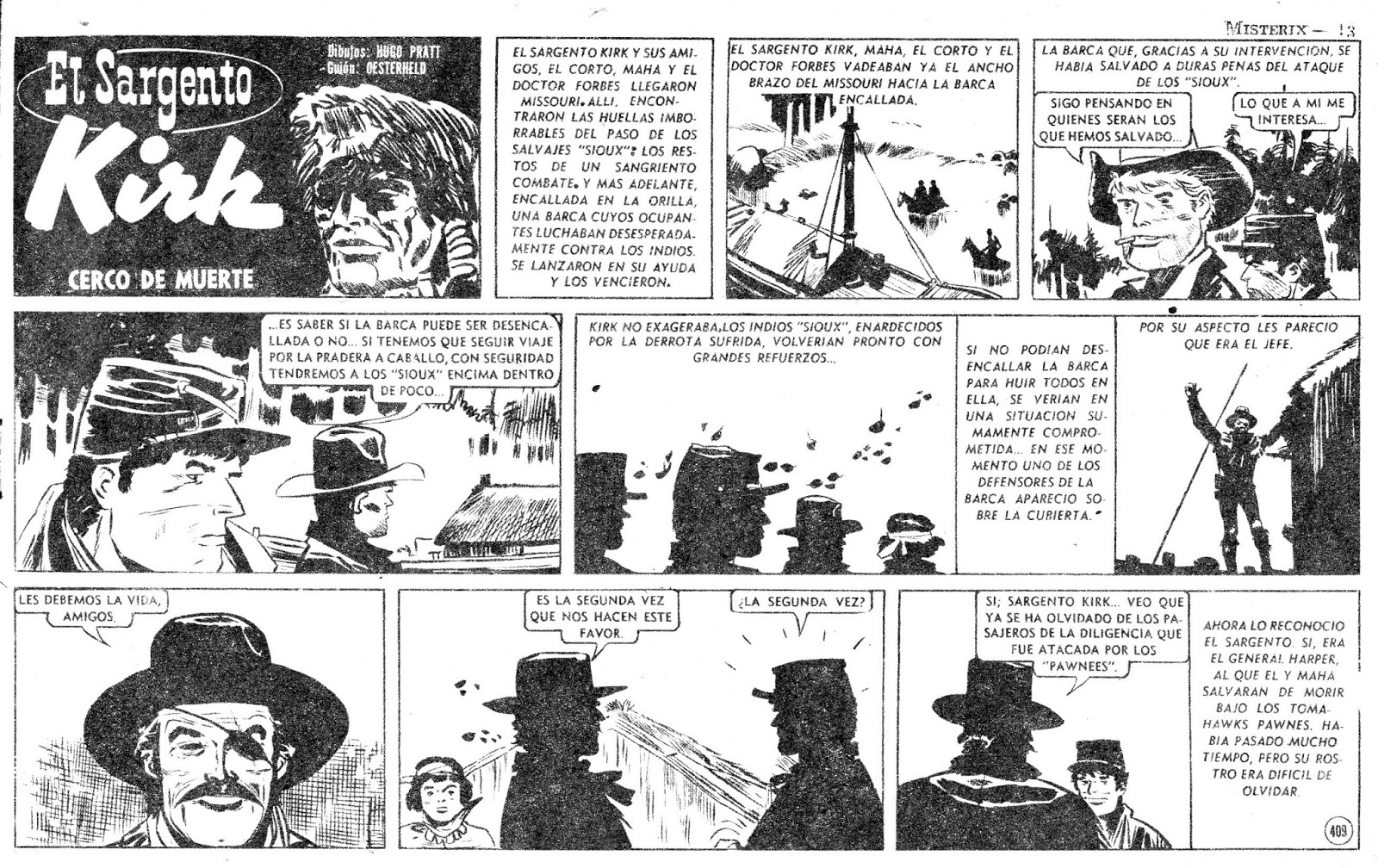
Héctor Germán Oesterheld (w), Hugo Pratt (a), "Cerco de muerte" [deathly siege], Misterix # 300, June 18, 1954 (page 409 of the "Sgt. Kirk" series).


Héctor Germán Oesterheld (w), Hugo Pratt (a), "Cerco de muerte" [deathly siege], Misterix # 300, June 18, 1954 (page 410 of the "Sgt. Kirk" series)..


Héctor Germán Oesterheld (w), Hugo Pratt (a; with someone else?), "La barca del Missouri" [the Missouri barge], Kirk Western # 1, 1976 (mock up for page 34).

As you can see above page 34 of the Italian (Cenisio) edition reprints one panel pf page 409 of the series (with the left arm of General Harper and some trees added on the left) and the first tier of page 410. The second panel of page 34 is also considerably altered with some ominous wind coming from the right side of the panel added and general Harper separated from Kirk and Dr. Forbes. To do this the anonymous drawer needed to add another left arm: Kirk's this time. The caption on the left of General Harper's daughter was suppressed, the shape of the speech balloons was altered also. In the end there's more negative space in the Cenisio edition and everything is less organic. You may say that the Italian edition is less cluttered, but it the decluttering is at the expense of Oesterheld's text, well... Again, though, this is a fake comic if I ever saw one.

Just for the fun of it I'll give you another example (lacking also the original, beautiful color) with the printed page this time. Notice the Ivaldi number "304" that the Cenisio hack didn't even bother to erase. The cuts reduced the pages from 398 to 304.


 Héctor Germán Oesterheld (w), Hugo Pratt (a), Stefan Strocen (c), "Cerco de muerte" [deathly siege], Misterix # 298, June 4, 1954 (page 398 of the "Sgt. Kirk" series).


Héctor Germán Oesterheld (w), Hugo Pratt (a; with someone else?), "La barca del Missouri" [the Missouri barge], Kirk Western # 1, 1976 (mock up for page 14).


Héctor Germán Oesterheld (w), Hugo Pratt (a; with someone else?), "La barca del Missouri" [the Missouri barge], Kirk Western # 1, 1976 (page 14 as reprinted in the magazine).

PS  I noticed that the last but one panel of page 398 (last panel of page 14) may show another hand on the left side in the cross-hatching. Maybe I should say, then: art by Hugo Pratt and anonymous ghost artist. It's known that Hugo Pratt used ghosts, Gisela Dester and Mario Bertolini among them. This doesn't mean that the Editorial Abril page is in any way a fake. It just means that some hands remain uncredited.